My Publications
THE CONCEPT OF FAIR HEARING AND EXAMINATION MALPRACTICES IN NIGERIA HIGHER INSTITUTIONS
Djoma Victor Ovuakporoye, Obani Izuchukwu Precious,
2025
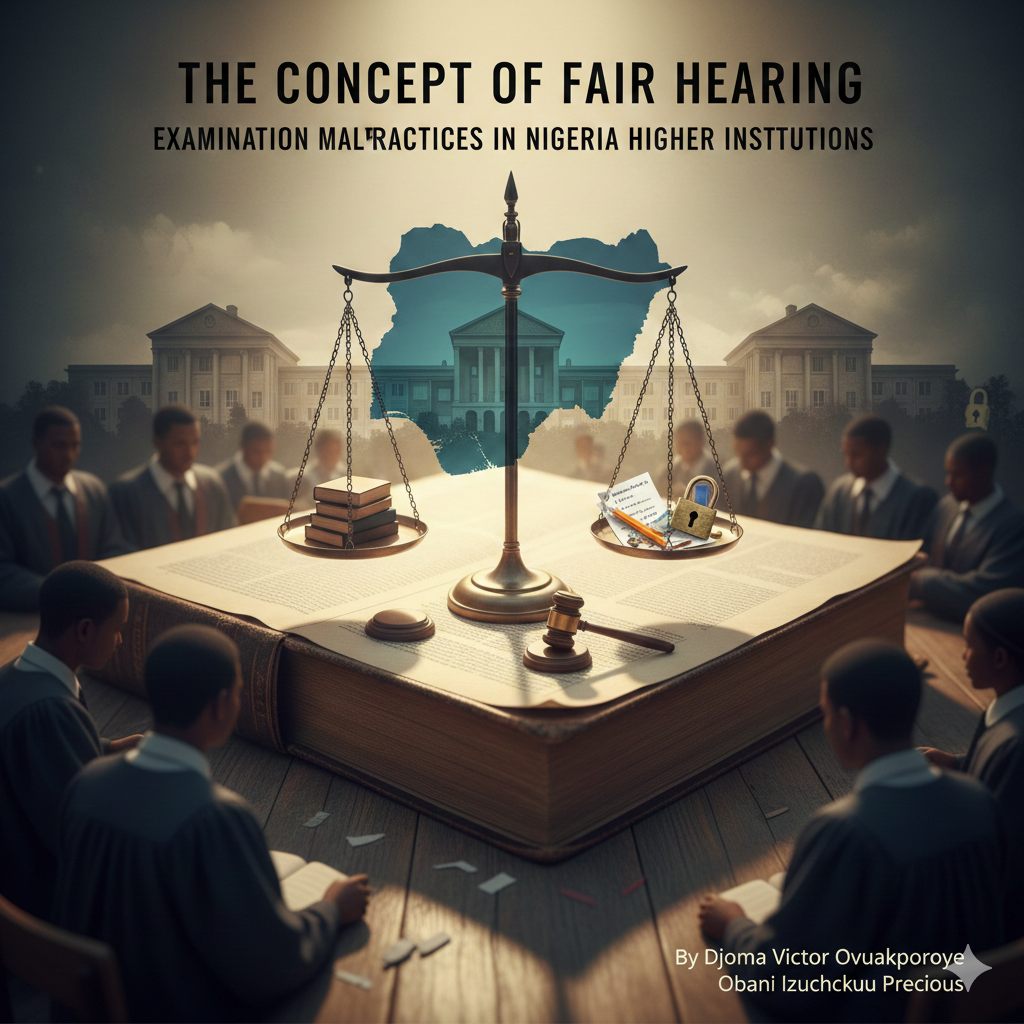
Fairness in examinations is a central ethical principle that sustains trust in educational systems and ensures that learners are assessed equitably on the basis of merit. Examination malpractices, however, undermine this principle by distorting assessment outcomes and eroding integrity in both education and society. Such malpractices include impersonation, leakage of questions, bribery, collusion, and the misuse of technology. This paper examines the concept of fairness and the persistence of examination malpractices in Nigerian tertiary institutions, with attention to their ethical, human rights, and developmental implications. The study adopts a critical analytic and descriptive method, drawing on relevant literature, policy documents, and case examples from Nigerian higher institutions to interrogate the underlying causes of examination malpractices and their impact on academic integrity. The paper finds that weak institutional frameworks, poor value orientation, inadequate supervision, and the misuse of digital technologies have deepened the problem, threatening fair assessment, promoting corruption, and undermining students’ learning outcomes. It further observes that although technological tools such as Artificial Intelligence (AI) and e-proctoring can help to curb malpractice, they require ethical deployment and human accountability. The paper concludes that fostering fairness in examinations requires a combination of value-driven education, transparent policies, accountability among stakeholders, and appropriate technological innovations. Strengthening fairness in assessment is therefore essential for building trust in educational qualifications, promoting integrity, and advancing sustainable development in contemporary society.