My Publications
'Igbo-Made' Ingenuity and Frugal Bricolage: Circular Economy Adaptations to Institutional Failures
Izuchukwu Precious Obani, Zino Izu-Obani, Elakhe Gamaliel Emode , Theresa Ojevwe Akroh,
2026
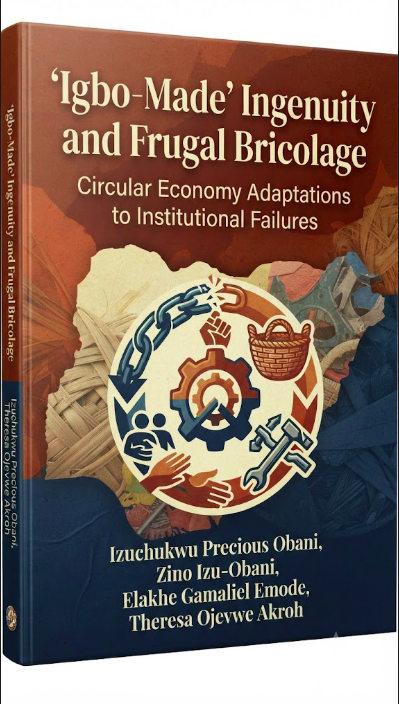
Dominant eco-innovation and circular economy frameworks are largely grounded in the institutional conditions of advanced economies, where firms benefit from reliable infrastructure, accessible finance, technological capabilities and predictable regulatory systems. This study examines how environmentally beneficial innovation emerges under contrasting conditions of institutional fragility, infrastructural instability and persistent resource scarcity. Drawing on organisational bricolage theory, the study investigates the adaptive practices associated with “Igbo-made” ingenuity among Nigerian small and medium-sized enterprises operating across manufacturing, recycling, logistics and agri-processing sectors. A qualitative research design informed by critical realism and pragmatism was adopted. Semi-structured interviews were conducted with ten SME owner-managers, and the data were analysed using the Gioia methodology alongside abductive and retroductive reasoning. The findings identify three interconnected forms of adaptation: material bricolage through waste-to-value practices, mechanical bricolage through informal engineering and technical modification, and infrastructure substitution through off-grid and closed-loop resource systems. These practices extended machinery lifecycles, transformed waste into productive inputs, reduced dependence on imported materials and supported operational continuity amid energy and financial constraints. However, participants rarely described their actions using formal sustainability or circular economy terminology. Environmental benefits emerged primarily from cost pressures, resource limitations and survival imperatives. The study develops the concept of Survivalist Eco-Innovation to explain environmentally beneficial practices generated through the interaction of institutional friction, entrepreneurial bricolage and organisational survival. It contributes to eco-innovation, circular economy and sustainability transition scholarship by demonstrating that ecological adaptation may emerge through informal, decentralised and necessity-driven innovation rather than formal environmental governance alone.